So I've gone all shape-shifter with my fiction this week... (and because I'm on holiday for winter-een-mas everything is running late this week, including this blog... lie-ins and gaming take priority. ;) )
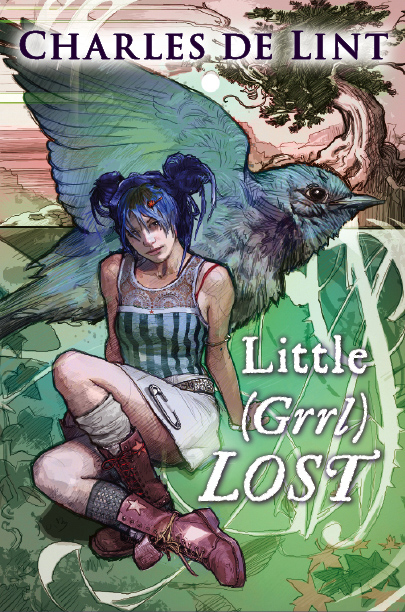
Starling was another flash fiction inspired by a piece of artwork, the cover of Little (Grrl) Lost by Charles de Lint, by Scott M. Fischer. Although I originally saw the image clean (i.e. without text). You can see what I've taken from the image and what I've altered and what I've made up. There's something of myself in the piece as well, I miss dancing. I miss it a lot.
I really like the shift in Starling, it jars a little, as it is supposed to. It's slightly unexpected and I think that jerky, flighty sentence actually captures something of the movement of a flock on the ground. It's supposed to make you stop and re-read and try to work out what's happening. Think of it as a forced double take, as if you'd caught sight of it actually happening in real life... 'wait, what just happened?'
Moonlight features a similar shift, an (I hope) unexpected one. I like the way it plays out, and that I take any ambiguity from the piece by the end. It starts of unsure and solidifies by the end, I hope it bears re-reading, encourages it even (in a good way of course).
Both pieces shy away from being too ambiguous by close of play. While I definitely think ambiguity has it's place, it's possible to leave people too confused. It can be a turn off if not handled properly. Think of it like spun sugar... it can look great and add a perfect element of sweetness, but overdo it and it looks like a mess and buries the other flavours.
The whole purpose of the Xeroverse, both Missing Pieces and 101 is to play with form and genre. Well, actually the primary purpose is to entertain, but for me it's the opportunity to do that with a variety of styles and characters. To explore both myself and other worlds.
The other thing that has shifted this week is Metamorphosis, my experimental piece of flash fiction. It will never be finished, but it will always be done. Until I next visit it... The interesting thing I've found is that it's not so easy to move things on and change things so dramatically purely through the editing process. The story has shifted, but more in point of view than in fact. It was supposed to tell different stories but through the process of shifting in small parts. It might still, who knows..? ;)
I've just found the #FridayFlash project too, which is a great, weekly, source of new flash from loads of different people. It's also brought a few new people to the Xeroverse, which is very cool; I hope they like it here. =)
Saturday, 29 January 2011

Wednesday, 19 January 2011
Words like sharks
Sometimes I really stretch to tie the title of this blog in with the last piece of fiction... can you tell? ;)
If you really want me to tie the theme in further then think of flash with a twist as words circling their prey, a hint of intent above the surface, just waiting for the right moment to strike...
Love like a Shark was one of those titles I came up with and instantly loved. I had a rough idea of a story and just needed to research a little about telomerase and sharks... when I found out that the same thing that almost makes sharks immortal (by letting cells regenerate indefinitely) could promote cancer in humans (by letting cells regenerate indefinitely) the whole thing kind of fell into place.
It's something I wrote a while ago, so I can't remember exactly what was behind my decision to write it in this script style. I do like to try different things though. It's good to mix things up and keep things interesting. New can be fresh. It can also be disastrous, of course, but for something of this length I think this style works.
101 has started well, I think, speaking of new things... Starting with Geek, one of the first ideas I had and the first piece I wrote for it, followed by iThing, my tribute to the Apple phenomenon and the most recent 101 I had written (until yesterday). It's one of my favourites.
And yesterday I posted Pan, another one of the early pieces I wrote and one that I had to work very hard to get down to the 101 words mark. A lot of my initial inspiration comes from artwork, and Pan was inspired by a painting by Dennis Nolan featured on page 190 of Spectrum vol. 2.
I love the Spectrum series, mostly for the variety of art you see and the generally high standards. Just flicking through I find the images often inspire stories in me, directly or tangentially. So I'm pretty excited that my copy of Spectrum 17 just turned up (a bit late, I know, but my initial order got lost somewhere down the line). I'm working on filling in the backlist too, I've been collecting for a few years, but it's been going for a while longer than that and I'm looking forward to filling in the gaps.
You might have also noticed the Twitter feed... @Xeroverse will have all fiction by John Xero linked wherever it might be posted. Obviously that's mostly on the two blogs, but I hope it'll be elsewhere too...
If you really want me to tie the theme in further then think of flash with a twist as words circling their prey, a hint of intent above the surface, just waiting for the right moment to strike...
Love like a Shark was one of those titles I came up with and instantly loved. I had a rough idea of a story and just needed to research a little about telomerase and sharks... when I found out that the same thing that almost makes sharks immortal (by letting cells regenerate indefinitely) could promote cancer in humans (by letting cells regenerate indefinitely) the whole thing kind of fell into place.
It's something I wrote a while ago, so I can't remember exactly what was behind my decision to write it in this script style. I do like to try different things though. It's good to mix things up and keep things interesting. New can be fresh. It can also be disastrous, of course, but for something of this length I think this style works.
101 has started well, I think, speaking of new things... Starting with Geek, one of the first ideas I had and the first piece I wrote for it, followed by iThing, my tribute to the Apple phenomenon and the most recent 101 I had written (until yesterday). It's one of my favourites.
And yesterday I posted Pan, another one of the early pieces I wrote and one that I had to work very hard to get down to the 101 words mark. A lot of my initial inspiration comes from artwork, and Pan was inspired by a painting by Dennis Nolan featured on page 190 of Spectrum vol. 2.
I love the Spectrum series, mostly for the variety of art you see and the generally high standards. Just flicking through I find the images often inspire stories in me, directly or tangentially. So I'm pretty excited that my copy of Spectrum 17 just turned up (a bit late, I know, but my initial order got lost somewhere down the line). I'm working on filling in the backlist too, I've been collecting for a few years, but it's been going for a while longer than that and I'm looking forward to filling in the gaps.
You might have also noticed the Twitter feed... @Xeroverse will have all fiction by John Xero linked wherever it might be posted. Obviously that's mostly on the two blogs, but I hope it'll be elsewhere too...
Sunday, 9 January 2011
Shaking Things Up
It's 2011, a week and a half gone by already, and a new year means a new look at things. It's an excuse to talk that way anyway. All those things you've been putting off because you were waiting for the new year, well you'd better be doing them now... ;)
So what's new in the Xeroverse? Well, 101 has now officially launched with the charming little story: Geek. It's a quick read, that's the point. Not only is the one hundred word limit an experiment and a challenge in form (forms, really, as I shall be trying to see just how far I can experiment within those hundred words), but it's short. In an effort to get attention on the internet, not only do you have to be good, but you have to allow for people's browsing attention spans.
I hope I'm good, I think I'm good. But it's difficult to get noticed on the internet. Because everybody is trying to get noticed on the internet. Now I'm not saying that people no longer have the attention span to read a longer short story or a novel, that blatantly isn't true, but when they're in internet mode most people will be flicking from page to page, and if there is no picture (and let's face it, the internet is a very visual medium) you have to work hard to keep hold of someone. I think if they can see the end of the story without having to scroll down then they might just read the whole thing, and if it's good, maybe another, and if they like that, than maybe they'll go on to read something longer. I hope.
Which kind of leads me nicely to my next new thing... At the bottom of my most recent Missing Piece: The Dull Sky Shook, I've linked to a piece of micro-fiction written by someone else. Someone I don't know. It's something I should have been doing all along. It's called 'recommended reading', and that's just what it is. Something I've read, that I've liked reading, that I think you will too.
I would love someone to read my work and like it enough to point people in this direction, so I should be doing exactly that for other people. I'll try and include a recommendation every week, but obviously that is somewhat dependant on me reading something that I want to recommend.
While I was browsing through micro/ flash fiction sites I came across someone talking about how they had loved the community they found; how they were so impressed with how much it was about 'go check this person out, they're awesome, first and oh, please read my work too, second.' It pains me that I can't find the original source now (stupid, stupid internets), but I think it was while I was browsing around the new Matter Press site.
So this is me going 'check this piece out, it's awesome'. It's about getting noticed, but it's about getting everyone noticed. Because I would love a larger audience, but so would other writers, and I'm no more deserving than them. It's not just about me, it's about micro/flash fiction, it's about storytelling; more importantly, it's about good storytelling and sharing that with as many people as possible... whether it be my story or yours.
So what's new in the Xeroverse? Well, 101 has now officially launched with the charming little story: Geek. It's a quick read, that's the point. Not only is the one hundred word limit an experiment and a challenge in form (forms, really, as I shall be trying to see just how far I can experiment within those hundred words), but it's short. In an effort to get attention on the internet, not only do you have to be good, but you have to allow for people's browsing attention spans.
I hope I'm good, I think I'm good. But it's difficult to get noticed on the internet. Because everybody is trying to get noticed on the internet. Now I'm not saying that people no longer have the attention span to read a longer short story or a novel, that blatantly isn't true, but when they're in internet mode most people will be flicking from page to page, and if there is no picture (and let's face it, the internet is a very visual medium) you have to work hard to keep hold of someone. I think if they can see the end of the story without having to scroll down then they might just read the whole thing, and if it's good, maybe another, and if they like that, than maybe they'll go on to read something longer. I hope.
Which kind of leads me nicely to my next new thing... At the bottom of my most recent Missing Piece: The Dull Sky Shook, I've linked to a piece of micro-fiction written by someone else. Someone I don't know. It's something I should have been doing all along. It's called 'recommended reading', and that's just what it is. Something I've read, that I've liked reading, that I think you will too.
I would love someone to read my work and like it enough to point people in this direction, so I should be doing exactly that for other people. I'll try and include a recommendation every week, but obviously that is somewhat dependant on me reading something that I want to recommend.
While I was browsing through micro/ flash fiction sites I came across someone talking about how they had loved the community they found; how they were so impressed with how much it was about 'go check this person out, they're awesome, first and oh, please read my work too, second.' It pains me that I can't find the original source now (stupid, stupid internets), but I think it was while I was browsing around the new Matter Press site.
So this is me going 'check this piece out, it's awesome'. It's about getting noticed, but it's about getting everyone noticed. Because I would love a larger audience, but so would other writers, and I'm no more deserving than them. It's not just about me, it's about micro/flash fiction, it's about storytelling; more importantly, it's about good storytelling and sharing that with as many people as possible... whether it be my story or yours.
Sunday, 2 January 2011
Snappy Titles
I often try to work out what leads a story to be more narrative or image (see previous post). Sometimes an idea for a story comes to me, sometimes it's a character and sometimes it's just a title. I'd been swaying towards thinking that just working from a title often resulted in more of an image because I just sat down and let the words fall out; so I wrote the title rather than titling the story, if that makes sense.
Not so, apparently. Cold Snap is the kind of pun I love. It came to me in a flash (with the weather, obviously) cold snap, a turn in the weather, a neck broken in cold blood... perfect.
And what came out was one of the strongest narratives that I think Missing Pieces has seen so far. That's one of the reasons it's the second piece in this chapter, it sets a nice contrast with the first, both strong pieces (imo) but in very different ways.
So what difference does a title make? Well, it fires the imagination, it can set up a twist, it can round off a good story and make it excellent. Maybe not as important as the first line it nevertheless begins the work on the reader's impression of the piece. It is likely to be the first thing they see so it has to have some kind of punchy appeal or instil instant curiosity (depending on the market of course).
There are lots of things that round off a story. And the hard thing with micro-fiction is working them all into a piece. The fewer words you have to work with the more work they have to do. Cold Snap is one of the longest Missing Pieces, one of the few that will ever break the 1000 word barrier, so it better do a lot if I'm to justify that. To break it down, I've tried to include a sense of the greater world the characters inhabit, there are more places than just the story location, more people than just the lead characters. There is a greater twist than just the obvious (I hope), it would have made a more typical micro-fiction if he had just broken her neck, or if the twist had been for her to break his.
You could deepen the characterisation of course, work it more to short story length, work a lot more on Sami's motivation for breaking her neck, build the feeling of xenophobic aggression, then maybe build on his reaction and strengthen their relationship on the way back to the village. But then you could say that about almost any short (or short, short) story. Even the most perfect, short snappy piece might be an equally fulfilling longer piece.
It's also worth pointing out the names are all genuine Nordic names. It's something I was once advised to think about, when I had a propensity for making up ridiculous fantasy names. Real names sound more real. They can lend more credence to a story. I still sometimes go for the more ridiculous made up names, when I think they're appropriate or I'm intentionally going for a clichéd approach. But I think the more you mature as a writer the more you learn how you need to think about each part of a story (and how important each part is to the whole). It would have been just as wrong to call the characters in Cold Snap Gorath and Elee'ia as it would have been to call them Bob and Sally.
Not so, apparently. Cold Snap is the kind of pun I love. It came to me in a flash (with the weather, obviously) cold snap, a turn in the weather, a neck broken in cold blood... perfect.
And what came out was one of the strongest narratives that I think Missing Pieces has seen so far. That's one of the reasons it's the second piece in this chapter, it sets a nice contrast with the first, both strong pieces (imo) but in very different ways.
So what difference does a title make? Well, it fires the imagination, it can set up a twist, it can round off a good story and make it excellent. Maybe not as important as the first line it nevertheless begins the work on the reader's impression of the piece. It is likely to be the first thing they see so it has to have some kind of punchy appeal or instil instant curiosity (depending on the market of course).
There are lots of things that round off a story. And the hard thing with micro-fiction is working them all into a piece. The fewer words you have to work with the more work they have to do. Cold Snap is one of the longest Missing Pieces, one of the few that will ever break the 1000 word barrier, so it better do a lot if I'm to justify that. To break it down, I've tried to include a sense of the greater world the characters inhabit, there are more places than just the story location, more people than just the lead characters. There is a greater twist than just the obvious (I hope), it would have made a more typical micro-fiction if he had just broken her neck, or if the twist had been for her to break his.
You could deepen the characterisation of course, work it more to short story length, work a lot more on Sami's motivation for breaking her neck, build the feeling of xenophobic aggression, then maybe build on his reaction and strengthen their relationship on the way back to the village. But then you could say that about almost any short (or short, short) story. Even the most perfect, short snappy piece might be an equally fulfilling longer piece.
It's also worth pointing out the names are all genuine Nordic names. It's something I was once advised to think about, when I had a propensity for making up ridiculous fantasy names. Real names sound more real. They can lend more credence to a story. I still sometimes go for the more ridiculous made up names, when I think they're appropriate or I'm intentionally going for a clichéd approach. But I think the more you mature as a writer the more you learn how you need to think about each part of a story (and how important each part is to the whole). It would have been just as wrong to call the characters in Cold Snap Gorath and Elee'ia as it would have been to call them Bob and Sally.
Wednesday, 29 December 2010
Flaming Metaphors
And so chapter 2 begins. Picking the opening piece was difficult. It had to be what I considered one of the better pieces, for one. I read a lot of anthologies, and much like the first line, or first paragraph of a novel, the first story has to be a good one. It sets the tone. Open on a stinker and you have to work hard to get the reader back on board, you're making life harder for yourself.
So I thought I would open simply. I really like the imagery in Fire and Eternity, and you can just take it for that. For me painting a picture. Or you could take it for the metaphor it is (or, more accurately 'was', at the time of writing).
There's a hint of phoenix myth in there too, whenever I write about flames and wings there always will be. The phoenix myth, and the differences between the Eastern and Western iterations of the myth, makes such sweet metaphor. And I do love my metaphors, the obvious ones and the less so. Which again, makes it a good pick: Here Be Metaphors, you have been warned. ;)
Something else I've been thinking about recently, since a piece of mine was rejected for being too much imagery and not enough story, is the importance of narrative and 'beginning, middle and end' in micro-fiction. Fire and Eternity is a scene, an image, not so much a story, although there is a story there. It is an 'end', although it could equally well be a 'middle', or even the 'beginning' of something...
And that's precisely one of the things I love about micro (or flash) fiction. It's right there in my profile, I'm looking to create seeds, I'm looking to hint at the greater story, to tell a story that is thousands of words long in just a thousand words or less. And it might be a different story in different people's heads (which is awesome).
The next Missing Piece is much more story. It has a beginning, middle and end. Although as with every story, something came before, and things will come after. However, it has more narrative, and character development. It is a very recent piece, where F&E is much older. It should set a nice contrast to Fire and Eternity, in more ways than one.
In the meantime, there's another piece of mine, Worship, over on Ink, Sweat and Tears as part of their Twelve Days of Christmas. Again, this one is more of a scene, and definitely a metaphor (or an allegory, you choose ;) ). Enjoy.
So I thought I would open simply. I really like the imagery in Fire and Eternity, and you can just take it for that. For me painting a picture. Or you could take it for the metaphor it is (or, more accurately 'was', at the time of writing).
There's a hint of phoenix myth in there too, whenever I write about flames and wings there always will be. The phoenix myth, and the differences between the Eastern and Western iterations of the myth, makes such sweet metaphor. And I do love my metaphors, the obvious ones and the less so. Which again, makes it a good pick: Here Be Metaphors, you have been warned. ;)
Something else I've been thinking about recently, since a piece of mine was rejected for being too much imagery and not enough story, is the importance of narrative and 'beginning, middle and end' in micro-fiction. Fire and Eternity is a scene, an image, not so much a story, although there is a story there. It is an 'end', although it could equally well be a 'middle', or even the 'beginning' of something...
And that's precisely one of the things I love about micro (or flash) fiction. It's right there in my profile, I'm looking to create seeds, I'm looking to hint at the greater story, to tell a story that is thousands of words long in just a thousand words or less. And it might be a different story in different people's heads (which is awesome).
The next Missing Piece is much more story. It has a beginning, middle and end. Although as with every story, something came before, and things will come after. However, it has more narrative, and character development. It is a very recent piece, where F&E is much older. It should set a nice contrast to Fire and Eternity, in more ways than one.
In the meantime, there's another piece of mine, Worship, over on Ink, Sweat and Tears as part of their Twelve Days of Christmas. Again, this one is more of a scene, and definitely a metaphor (or an allegory, you choose ;) ). Enjoy.
Wednesday, 22 December 2010
Finding Lost Things
But what shall I talk about with no story to launch the discussion off!?
As I was publishing (blogging?) most of the first chapter of Missing Pieces I already had the rest written. So my week would go something like: post/edit/commentary/blog/edit/post and so on. Since for the past few weeks I've been writing the next chapter this quite chilled pace has been disrupted. It's been post/write/edit/write/write/write/write/write and so on. So my SF blog and other endeavours fall by the wayside a little.
I don't mind. I love writing. That's kind of the point. I don't mind if I never do this for money (although, you know...), I mostly want to tell stories. That does of course mean I want people to read my work, and like it... I want to tell the stories to someone. The larger the audience, the better... one day, maybe.
In the meantime. I'll just keep myself and my friends entertained. =)
So I'm just about to start publishing the next chapter of Missing Pieces. It's about half written, a little more than, which makes it different to the first chapter which was pretty much finished when I started. I'm also picking the order in which they're published, instead of the first chapter which was in the order they were written (except for a couple of festive concessions). There's a really good mix (I think), of genres and lengths and styles. There's some more fanciful, playful pieces, some serious fantasy, some heavy SF... it's gonna be fun. ;D
One of the things that (hopefully) you'll see coming through in the later half of this chapter is a major influence on my life... Roald Dahl. I read all of the kids' books when I was younger, but I'm just now reading some of his adult stories, some of his Unexpected Tales. I can't believe I managed to do a creative writing degree and was never made to read these. They are, for the most part, so well handled; the characterisation, pacing and plot development are superb. And taking the obvious twist, nodding at it and passing it by... is brilliant. If you like short fiction, you should read them.
As I was publishing (blogging?) most of the first chapter of Missing Pieces I already had the rest written. So my week would go something like: post/edit/commentary/blog/edit/post and so on. Since for the past few weeks I've been writing the next chapter this quite chilled pace has been disrupted. It's been post/write/edit/write/write/write/write/write and so on. So my SF blog and other endeavours fall by the wayside a little.
I don't mind. I love writing. That's kind of the point. I don't mind if I never do this for money (although, you know...), I mostly want to tell stories. That does of course mean I want people to read my work, and like it... I want to tell the stories to someone. The larger the audience, the better... one day, maybe.
In the meantime. I'll just keep myself and my friends entertained. =)
So I'm just about to start publishing the next chapter of Missing Pieces. It's about half written, a little more than, which makes it different to the first chapter which was pretty much finished when I started. I'm also picking the order in which they're published, instead of the first chapter which was in the order they were written (except for a couple of festive concessions). There's a really good mix (I think), of genres and lengths and styles. There's some more fanciful, playful pieces, some serious fantasy, some heavy SF... it's gonna be fun. ;D
One of the things that (hopefully) you'll see coming through in the later half of this chapter is a major influence on my life... Roald Dahl. I read all of the kids' books when I was younger, but I'm just now reading some of his adult stories, some of his Unexpected Tales. I can't believe I managed to do a creative writing degree and was never made to read these. They are, for the most part, so well handled; the characterisation, pacing and plot development are superb. And taking the obvious twist, nodding at it and passing it by... is brilliant. If you like short fiction, you should read them.
Friday, 10 December 2010
Writing Nightmares
Ambiguity is always fun in writing. Getting the balance right is hard though.
Make it too obvious, give too much away and the reader is left feeling disappointed. Make it too obscure, and the reader is left confused.
Of course, this also depends on what you are trying to achieve. Do you want it unclear, or do you want it resolved, but with an edge of uncertainty. I mean, once the beast is slain, do you want it unclear as to whether the beast really killed everyone or if it was one of the protagonists... or do you want the beast slain, but a flash of something dark in one of the protagonist's eyes, the beast lives on in them?
Hmm... that wasn't entirely clear was it. It may be even harder to write about writing ambiguously than the ambiguous writing itself.
So in This Bedtime Story are Audrey's devils real, or are they just night terrors she has conjured up over missing her father? Obviously, I like the weird, so I'd like to think their is more to this world than most of us get to experience. If you know my writing you'll probably er on the side of the weird being the truth. But then, maybe those are just the nightmares of a child with imagination, the early stages of a writer like me.
I tend to try for the less obvious edge of ambiguity. I guess I'd rather leave someone confused than disappointed. Certainly in the past I know I've left people more in a state of WTF than I might have intended. But I would rather credit readers with intelligence than think they need everything spelled out to them.
There is danger in overworking it too. Less so in micro-fiction maybe. The X-Files, for example, was better when it was just It's aliens! No it's the government! when it carried on a few seasons with aliens/ government/ aliens/ government/ aliens/ government ad nauseum, I got a bit bored.
Ideally, obviously, you want to hit that sweet spot. Where the reader thinks they know what the truth is, but there is still a delicious edge of what if?, a splash of maybe.
There's a distinction to be made between ambiguity and suspense too. Or maybe a demonstration of symbiosis. And I think I've really been talking about something between the two. Because ambiguity covers a whole lot more than just a suspenseful ending and a lingering sense of unfinished business, although it is a great tool for that kind of effect.
Sometimes, ambiguity can just be bad or unclear writing. But when it is intentional and controlled I think it is something brilliant and interesting. Ambiguity is the opening of a discussion between the reader and the writer. What do you think is happening here?
Make it too obvious, give too much away and the reader is left feeling disappointed. Make it too obscure, and the reader is left confused.
Of course, this also depends on what you are trying to achieve. Do you want it unclear, or do you want it resolved, but with an edge of uncertainty. I mean, once the beast is slain, do you want it unclear as to whether the beast really killed everyone or if it was one of the protagonists... or do you want the beast slain, but a flash of something dark in one of the protagonist's eyes, the beast lives on in them?
Hmm... that wasn't entirely clear was it. It may be even harder to write about writing ambiguously than the ambiguous writing itself.
So in This Bedtime Story are Audrey's devils real, or are they just night terrors she has conjured up over missing her father? Obviously, I like the weird, so I'd like to think their is more to this world than most of us get to experience. If you know my writing you'll probably er on the side of the weird being the truth. But then, maybe those are just the nightmares of a child with imagination, the early stages of a writer like me.
I tend to try for the less obvious edge of ambiguity. I guess I'd rather leave someone confused than disappointed. Certainly in the past I know I've left people more in a state of WTF than I might have intended. But I would rather credit readers with intelligence than think they need everything spelled out to them.
There is danger in overworking it too. Less so in micro-fiction maybe. The X-Files, for example, was better when it was just It's aliens! No it's the government! when it carried on a few seasons with aliens/ government/ aliens/ government/ aliens/ government ad nauseum, I got a bit bored.
Ideally, obviously, you want to hit that sweet spot. Where the reader thinks they know what the truth is, but there is still a delicious edge of what if?, a splash of maybe.
There's a distinction to be made between ambiguity and suspense too. Or maybe a demonstration of symbiosis. And I think I've really been talking about something between the two. Because ambiguity covers a whole lot more than just a suspenseful ending and a lingering sense of unfinished business, although it is a great tool for that kind of effect.
Sometimes, ambiguity can just be bad or unclear writing. But when it is intentional and controlled I think it is something brilliant and interesting. Ambiguity is the opening of a discussion between the reader and the writer. What do you think is happening here?
Subscribe to:
Posts (Atom)